

Running a business in the UAE without legal protection is like driving without insurance. Everything works fine until it doesn’t. And when it doesn’t, the costs multiply fast.
A single poorly drafted contract can expose you to millions in liability. One employment dispute handled wrong can trigger government penalties and visa restrictions. A compliance gap you didn’t know existed can put your trade licence at risk.
The companies that survive and grow here aren’t the ones that avoid legal problems. They’re the ones that build civil legal services for businesses into their operations from day one. This Logicway guide covers every category of legal protection your company needs in the UAE, why each one matters, and when to bring in professional help.
Why Every Company in the UAE Needs Legal Services
The UAE is one of the most business-friendly environments in the Middle East. But business-friendly doesn’t mean regulation-light. If anything, the pace of regulatory change here makes legal awareness more important, not less.
Consider what’s happened in the last two years alone. Federal Decree-Law No. 20 of 2025 amended the Commercial Companies Law, changing ownership provisions and corporate structures. Corporate tax at 9% on profits above AED 375,000 is now fully enforced. E-invoicing becomes mandatory by mid-2026. Emiratisation targets require private companies with 50 or more employees to reach a 10% rate in skilled roles by end of 2026. Civil procedure amendments under Federal Decree-Law No. 22 of 2025 changed how cases are filed, managed, and appealed.
Each of these changes creates obligations. Miss one, and you’re exposed to fines, licence issues, or litigation. A business legal consultancy in Dubai that tracks these changes for you isn’t a luxury. It’s basic risk management.
The real cost of skipping legal services isn’t the lawyer’s fee you saved. It’s the dispute that spirals, the contract that collapses, or the compliance penalty that freezes your operations.
The Core Civil Legal Services Every Business Needs
Not every company needs the same legal setup. A two-person consultancy has different risks than a 200-employee construction firm. But certain categories of civil legal services for businesses apply across the board in the UAE.
1. Contract Drafting and Review
Contracts are the backbone of every business relationship in the UAE. Supplier agreements, client contracts, partnership arrangements, lease agreements, employment contracts, NDAs, service level agreements. Every one of these is a potential dispute waiting to happen if the drafting is weak.
The most common contract problems businesses face in the UAE aren’t exotic legal issues. They’re basic drafting failures: vague payment terms, missing termination clauses, penalty provisions that conflict with UAE law, non-compete clauses drafted too broadly to be enforceable, and jurisdiction clauses that don’t match the parties’ actual locations.
What a civil lawyer does here:
- Reviews and drafts contracts in compliance with UAE Civil Code and Commercial Code
- Identifies clauses that UAE courts would likely strike down or interpret against you
- Adds dispute resolution mechanisms (mediation, arbitration, or court jurisdiction)
- Ensures Arabic translations match the English version (courts rely on the Arabic text)
- Builds in protections for intellectual property, confidentiality, and liability caps
One poorly worded termination clause can lock you into a bad deal for years. One missing arbitration clause can force you into court when a 30-day mediation would have resolved everything.
2. Employment and Labour Compliance
Employment disputes are among the most frequent legal headaches for businesses in the UAE. The Ministry of Human Resources and Emiratisation (MOHRE) takes worker protections seriously, and the consequences for non-compliance go beyond fines.
Areas where businesses commonly get caught out:
- Miscalculating end-of-service gratuity (one of the most litigated employment issues in the UAE)
- Using outdated employment contracts that don’t reflect the 2022 labour law reforms
- Overly broad non-compete clauses that courts refuse to enforce
- Failure to meet Emiratisation quotas (AED 6,000 per month per unfilled position in penalties)
- Incorrect handling of termination, notice periods, and final settlement payments
- Not providing mandatory benefits: annual leave, sick leave, maternity leave, overtime pay
MOHRE requires employers to attempt mediation before any employment dispute reaches court. If your contracts and HR policies are already compliant, most disputes resolve at this stage. If they’re not, you’re exposed to back-pay claims, penalties, and potential visa quota restrictions.
A corporate lawyer consultation in the UAE that audits your employment contracts and HR policies once a year can prevent the vast majority of these issues.
Know more about : Civil vs Criminal Law in UAE: Key Differences Explained
3. Company Formation and Licensing
The UAE offers three incorporation routes: mainland, free zone, and offshore. Each carries different consequences for banking access, visa quotas, government contracting eligibility, and regulatory obligations.
Since the removal of mandatory Emirati shareholding for most mainland activities, foreign investors can now own 100% of businesses across the majority of commercial and industrial sectors. But the legal structure you choose at formation follows you through every subsequent transaction, partnership, and dispute.
Legal services at the formation stage cover:
- Advising on the right structure (LLC, sole establishment, branch office, free zone entity)
- Drafting memoranda of association and shareholder agreements
- Licence application and activity code selection (every commercial activity requires a licence)
- Ultimate Beneficial Owner (UBO) registration (mandatory for all mainland and free zone companies)
- Structuring ownership to comply with sector-specific foreign ownership restrictions
Getting the structure wrong at formation doesn’t just create administrative headaches. It can affect your ability to win government contracts, open corporate bank accounts, sponsor employee visas, and even sell the business later.
4. Commercial Dispute Resolution
Disputes happen. Clients don’t pay. Suppliers deliver late. Partners disagree on direction. The question isn’t whether your business will face a dispute. It’s how quickly and cost-effectively you can resolve it.
The UAE legal system strongly encourages mediation and arbitration before formal litigation. Recent civil procedure reforms aim to reduce court backlogs by 40% by pushing more disputes through alternative resolution channels.
The dispute resolution spectrum in the UAE:
- Direct negotiation: Often the fastest resolution. A lawyer’s demand letter, drafted correctly, resolves many disputes before they escalate.
- Mediation: Mandatory for most civil cases before court filing. Each emirate has its own centre. Settlements reached through mediation are enforceable as court judgments.
- Arbitration: Common for high-value commercial disputes. The Dubai International Arbitration Centre (DIAC) and Abu Dhabi’s arbitration institutions handle cases that parties have agreed to arbitrate.
- Litigation: The formal court process through the Court of First Instance, Court of Appeal, and Court of Cassation. Takes three to 12 months at first instance depending on complexity.
Having a civil lawyer involved from the first sign of a dispute, not after it’s escalated, is the single biggest factor in controlling legal costs.
5. Debt Recovery and Financial Claims
Unpaid invoices are a persistent challenge for businesses in the UAE. The good news: the UAE legal system provides strong enforcement mechanisms once you have a judgment. The bad news: the process requires proper documentation from the start.
What a debt recovery service involves:
- Pre-legal demand letters and payment reminders (often enough to trigger payment)
- Filing a civil case for debt recovery through e-filing portals
- Obtaining court orders for asset freezing and travel bans against debtors
- Execution through the Execution Court (seizure of bank accounts, property, and assets)
- Cross-border debt enforcement using bilateral treaties and international agreements
Bounced cheques, while partially decriminalised, still carry civil liability. And if there’s evidence of fraud or bad faith, criminal proceedings can run parallel to your civil claim.
6. Real Estate and Tenancy Matters
Whether you’re leasing office space, buying commercial property, or managing a portfolio of rental units, real estate disputes are one of the most common categories of civil litigation in the UAE.
Typical legal needs for businesses in real estate:
- Reviewing and negotiating commercial lease agreements
- Handling Ejari registration and RERA compliance in Dubai
- Resolving landlord-tenant disputes through the Rental Dispute Centre (RDC)
- Managing property purchases, due diligence, and title transfers
- Dealing with construction delays, defects, and contractor disputes
Dubai’s rental market has specific regulations around rent increases, eviction notice periods, and maintenance obligations that differ from other emirates. A lease drafted without these specifics in mind leaves money on the table or creates exposure you didn’t plan for.
7. Intellectual Property Protection
Your brand, software, designs, and proprietary processes are assets. In the UAE, protecting them requires registration and enforcement.
IP services businesses commonly need:
- Trademark registration with the Ministry of Economy
- Copyright protection for original works, software, and creative content
- Patent applications for inventions and industrial designs
- Drafting NDA and IP assignment clauses in employment and contractor agreements
- Enforcement actions against infringers (cease and desist, civil claims, customs recordal)
The UAE takes IP seriously. Federal Decree-Law No. 36 of 2021 on Trademarks and Federal Law No. 38 of 2021 on Copyrights provide the framework, but enforcement requires proactive registration and monitoring.
8. Regulatory Compliance and Corporate Governance
Compliance in the UAE isn’t a one-time box to tick. It’s an ongoing obligation that changes as regulations evolve.
Current compliance areas every UAE business must manage:
- Corporate tax filing (9% on profits above AED 375,000)
- VAT compliance and the upcoming mandatory e-invoicing regime (mid-2026)
- Anti-money laundering (AML) obligations and suspicious transaction reporting
- Ultimate Beneficial Owner (UBO) registration and ongoing updates
- Economic Substance Regulations (ESR) for relevant activities
- Data protection under Federal Decree-Law No. 45 of 2021 (UAE’s data privacy law)
- Emiratisation quotas and MOHRE reporting
UAE law imposes personal liability on directors, managers, and officers for compliance failures under their oversight. In serious cases, this extends to criminal proceedings. Having legal advisors in Dubai, UAE who monitor regulatory changes and flag obligations before deadlines hit is the difference between smooth operations and crisis management.
When Should a Business Hire a Legal Consultant?
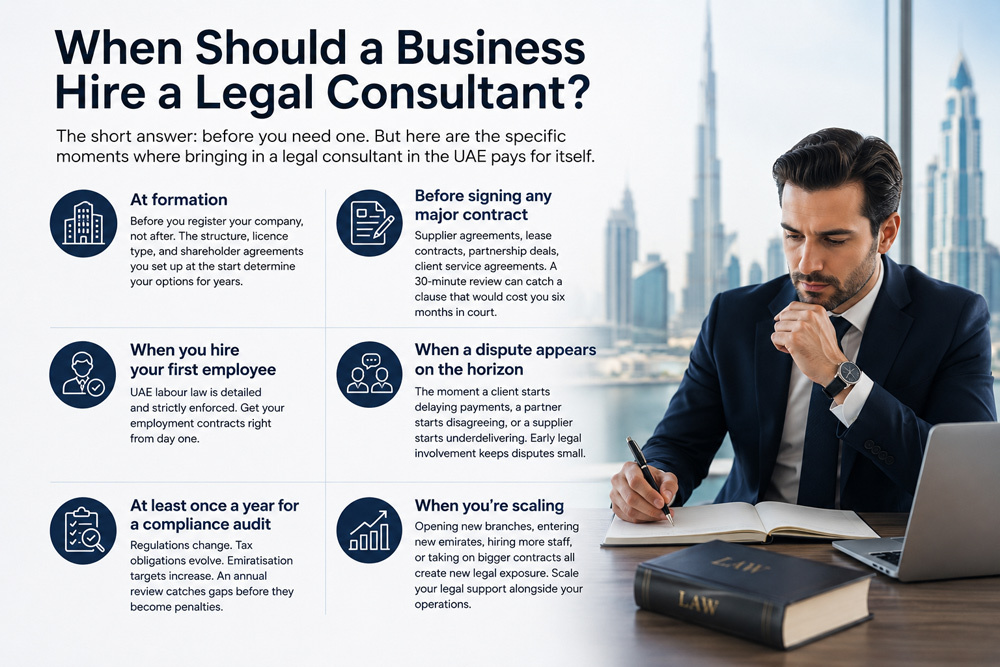
The short answer: before you need one. But here are the specific moments where bringing in an affordable legal consultancy in the UAE pays for itself.
At formation: Before you register your company, not after. The structure, licence type, and shareholder agreements you set up at the start determine your options for years.
Before signing any major contract: Supplier agreements, lease contracts, partnership deals, client service agreements. A 30-minute review can catch a clause that would cost you six months in court.
When you hire your first employee: UAE labour law is detailed and strictly enforced. Get your employment contracts right from day one.
When a dispute appears on the horizon: The moment a client starts delaying payments, a partner starts disagreeing, or a supplier starts underdelivering. Early legal involvement keeps disputes small.
At least once a year for a compliance audit: Regulations change. Tax obligations evolve. Emiratisation targets increase. An annual review with your business legal consultancy in Dubai catches gaps before they become penalties.
When you’re scaling: Opening new branches, entering new emirates, hiring more staff, or taking on bigger contracts all create new legal exposure. Scale your legal support alongside your operations.
How a Civil Lawyer Protects Your Business
A civil lawyer isn’t just someone you call when things go wrong. The best use of a corporate lawyer consultation in the UAE is preventative: structuring your business so problems don’t arise in the first place.
Proactive protection includes:
- Drafting contracts that hold up in UAE courts, not just contracts that sound reasonable
- Building dispute resolution clauses that save time and money when conflicts occur
- Conducting compliance audits that identify risks before regulators do
- Training your team on employment law obligations and documentation requirements
- Advising on corporate governance structures that protect directors and shareholders
Reactive protection includes:
- Representing your business in mediation, arbitration, and court proceedings
- Filing civil claims for debt recovery, breach of contract, and damages
- Defending against claims brought by employees, clients, or competitors
- Handling injunctions, asset freezes, and emergency court applications
- Managing cross-border legal issues and enforcement of foreign judgments
At Logicway, we work with businesses across Dubai and the UAE to build legal frameworks that prevent problems and resolve them quickly when they do arise. Whether you need ongoing civil legal services for businesses or a one-time corporate lawyer consultation in the UAE, the goal is the same: protecting what you’ve built.
What Civil Legal Services Cost in the UAE
Legal fees vary based on the complexity and scope of work. Here’s a general guide to what businesses can expect.
| Service | Typical Fee Range | Billing Model |
| Contract drafting/review | AED 2,000 – 15,000 | Per document |
| Company formation | AED 5,000 – 25,000 | Fixed fee |
| Employment law audit | AED 5,000 – 20,000 | Fixed fee |
| Debt recovery | AED 5,000 – 30,000+ | Fixed + % of recovery |
| Commercial dispute litigation | AED 15,000 – 100,000+ | Hourly or staged fee |
| Annual compliance retainer | AED 20,000 – 80,000/year | Monthly retainer |
| IP registration (trademark) | AED 4,000 – 10,000 | Per application |
An affordable legal consultancy in the UAE doesn’t mean cheap. It means proportionate: legal support scaled to your company’s size, risk profile, and budget. A startup doesn’t need a full-time general counsel. But it does need a lawyer who knows UAE law and can step in when it matters.
Need legal protection for your business? Logicway provides business legal consultancy in Dubai and across the UAE. From contract review to full compliance retainers, we offer affordable legal consultancy in the UAE tailored to your company’s size and needs. Get in touch for a corporate lawyer consultation today.
Frequently Asked Questions
Civil legal services for businesses cover all non-criminal legal support a company needs. That includes contract drafting and review, company formation, employment law compliance, commercial dispute resolution, debt recovery, intellectual property protection, real estate matters, and regulatory compliance. These services protect your business from financial loss, litigation risk, and regulatory penalties. In the UAE, where the legal environment shifts frequently, having a legal consultancy that covers these areas is a core business function, not an optional extra.
Every company operating in the UAE faces legal obligations: licensing requirements, tax compliance, employment law rules, data protection mandates, and contractual responsibilities. Non-compliance carries real consequences, including fines, licence suspension, visa quota restrictions, and personal liability for directors. Beyond compliance, legal services prevent disputes from escalating and protect your interests when they do. The cost of reactive legal help after a problem hits is always higher than proactive legal support built into your operations.
The most frequent legal issues include contract disputes (vague terms, missing clauses, unenforceable provisions), employment complaints (gratuity miscalculation, wrongful termination, non-compete violations), debt recovery from non-paying clients, commercial lease disagreements, intellectual property infringement, corporate tax and VAT non-compliance, and regulatory violations related to Emiratisation or AML requirements. Many of these issues are preventable with proper legal setup, which is exactly why civil legal services for businesses exist.
A civil lawyer protects your business in two ways. Proactively: drafting enforceable contracts, structuring your company correctly, ensuring compliance with UAE regulations, and building dispute resolution mechanisms into your agreements. Reactively: representing you in mediation, arbitration, or court when disputes arise, filing debt recovery claims, defending against employee or competitor claims, and handling emergency applications like asset freezes or injunctions. The best legal advisors in Dubai, UAE do both, so your business is protected before and during any legal challenge.
Before you register your company (to get the structure right), before signing any major contract, when you hire your first employee, when a dispute starts brewing, and at least annually for a compliance review. The biggest mistake businesses make is treating legal services as something you seek after a problem surfaces. By then, your options are limited and costs are higher. An affordable legal consultancy in the UAE on retainer pays for itself by catching problems early and keeping your business on the right side of UAE law.