

Someone wronged you. Maybe a business partner disappeared with your investment. Maybe a tenant trashed your property and vanished. Or maybe you received a police summons and have no idea why.
Your next move depends entirely on whether your situation falls under civil law or criminal law in the UAE. Get this wrong, and you’re knocking on the wrong door, wasting time, money, and whatever leverage you had.
The UAE legal system treats these two branches very differently. Different courts, different procedures, different burdens of proof, and very different consequences. This guide from Logicway breaks down exactly how civil and criminal law work in the UAE, where they overlap, and what it means for you.
What Is Civil Law in the UAE?
Civil law in the UAE governs disputes between private parties, whether individuals, companies, or organisations. The goal isn’t punishment. It’s resolution: putting the wronged party back in the position they should have been in, usually through financial compensation or a court order.
Civil cases are governed primarily by Federal Decree-Law No. 42 of 2022 (the Civil Procedure Code) and Federal Law No. 5 of 1985 (the Civil Transactions Code). These laws set out how disputes get filed, heard, and resolved.
Common types of civil cases in the UAE:
- Contract disputes between businesses or individuals
- Property and real estate disagreements, including tenancy conflicts
- Debt recovery and financial claims
- Insurance claim disputes
- Construction defect and delay claims
- Personal injury compensation (seeking damages for negligence)
- Intellectual property infringement
The party bringing the claim (the plaintiff) bears the burden of proving their case on the balance of probabilities. That’s a lower bar than criminal cases. You don’t need to prove beyond reasonable doubt. You need to show that your version of events is more likely true than not.
Outcomes in civil cases are compensatory, not punitive. The court may order monetary damages, specific performance of a contract, injunctions, or the return of property. Nobody goes to prison over a civil dispute alone.
What Is Criminal Law in the UAE?
Criminal law deals with offences against society and the state. When someone commits a crime in the UAE, it’s not just the victim who’s wronged. It’s the public order itself. That’s why criminal cases are prosecuted by the Public Prosecution, not by the victim directly.
The primary legislation is Federal Decree-Law No. 31 of 2021 (the UAE Penal Code), which replaced the older Federal Law No. 3 of 1987. Criminal procedures follow Federal Decree-Law No. 38 of 2022 (the Criminal Procedures Law). Both came into effect on 2 January 2022 and represent a significant modernisation of UAE criminal law.
The UAE Penal Code classifies offences into three categories:
- Contraventions (minor offences): Punishable by fines, community service, or short detention. These include minor traffic violations, public nuisance offences, and petty disturbances.
- Misdemeanours (mid-level offences): Punishable by imprisonment from one month to three years, fines, or both. Examples include simple assault, theft of low-value items, and certain fraud cases.
- Felonies (serious offences): Carry penalties of imprisonment exceeding three years, life imprisonment, or the death penalty in extreme cases. These cover murder, drug trafficking, serious fraud, and crimes against state security.
Common criminal offences in the UAE include:
- Theft and robbery (Article 443 of the Penal Code, minimum 6 months imprisonment)
- Fraud and forgery
- Assault and bodily harm
- Drug possession and trafficking
- Cybercrime offences (governed by Federal Decree-Law No. 34 of 2021)
- Bounced cheques with criminal intent
- Defamation and invasion of privacy
- Breach of trust and embezzlement (Article 453)
The burden of proof in criminal cases is significantly higher: proof beyond reasonable doubt. The prosecution must establish that the accused committed the offence, and any reasonable doubt works in the defendant’s favour.
To Know More : Criminal Complaint Procedure in Dubai: What You Need to Know in 2026
Key Differences Between Civil and Criminal Law in the UAE
Here’s a direct comparison of how these two branches operate:
| Factor | Civil Law | Criminal Law |
| Purpose | Resolve private disputes; compensate the wronged party | Punish offences against society and maintain public order |
| Who files | The affected individual or entity (plaintiff) | The Public Prosecution on behalf of the state |
| Burden of proof | Balance of probabilities (more likely than not) | Beyond reasonable doubt (highest standard) |
| Penalties | Financial compensation, injunctions, specific performance | Imprisonment, fines, deportation, death penalty (extreme cases) |
| Court structure | Civil Court of First Instance, Appeal, Cassation | Criminal Court of First Instance, Appeal, Cassation |
| Legal representation | Required for claims above AED 500,000 | Mandatory for felonies; recommended for all cases |
| Governing law | Federal Decree-Law No. 42/2022 (Civil Procedure) | Federal Decree-Law No. 31/2021 (Penal Code) |
| Mediation required? | Yes, for most disputes before filing | No; cases go directly through prosecution |
| Outcome if you lose | Pay compensation or comply with court order | Imprisonment, fines, criminal record, potential deportation |
How the Civil Court Process Works in Dubai and the UAE
Civil cases follow a structured path. The plaintiff consults a lawyer, gathers evidence, and attempts mediation or conciliation through the relevant centre (mandatory for most civil disputes). If mediation fails, the plaintiff receives a referral letter and files the case through the court’s e-filing portal.
The court registers the case, serves the defendant, and schedules hearings. Both parties present their arguments, submit evidence, and the judge may appoint expert witnesses for technical matters. After reviewing everything, the court issues a written judgment.
The process typically takes three to six months for straightforward claims. Contested or complex cases can stretch to 12 months or longer at the Court of First Instance level. Appeals add another two to six months.
The losing party in a civil case faces financial consequences, not imprisonment. They may be ordered to pay compensation, return property, perform contractual obligations, or cover the other party’s legal costs.
What Happens in a Criminal Case in Dubai
Criminal cases follow a very different track. They typically start with a police report filed at a police station or through the Ministry of Interior’s online platforms. The police investigate, collect evidence, and refer the case to the Public Prosecution.
The Public Prosecution decides whether to press charges. If they proceed, the case goes to the Criminal Court of First Instance. The accused has the right to legal representation, and for felonies, the court must appoint a lawyer if the accused cannot afford one.
The criminal trial process involves:
- Arraignment, where the charges are formally read
- Presentation of prosecution evidence and witness testimony
- The defence’s response, cross-examination, and counter-evidence
- Expert testimony if needed (forensic, financial, technical)
- The judge’s verdict and sentencing
Penalties under UAE criminal law are serious. Fines can range from a few thousand dirhams for contraventions to millions for corporate offences (up to AED 5 million for legal entities under the Penal Code). Imprisonment ranges from days for minor offences to life sentences for the most severe crimes. Deportation after serving a sentence is common for non-UAE nationals convicted of criminal offences.
The accused can appeal to the Court of Appeal within 15 days of the verdict (compared to 30 days for civil cases). A further appeal to the Court of Cassation is available on points of law.
Can a Civil Case Become Criminal in the UAE?
Yes, and it happens more often than people expect.
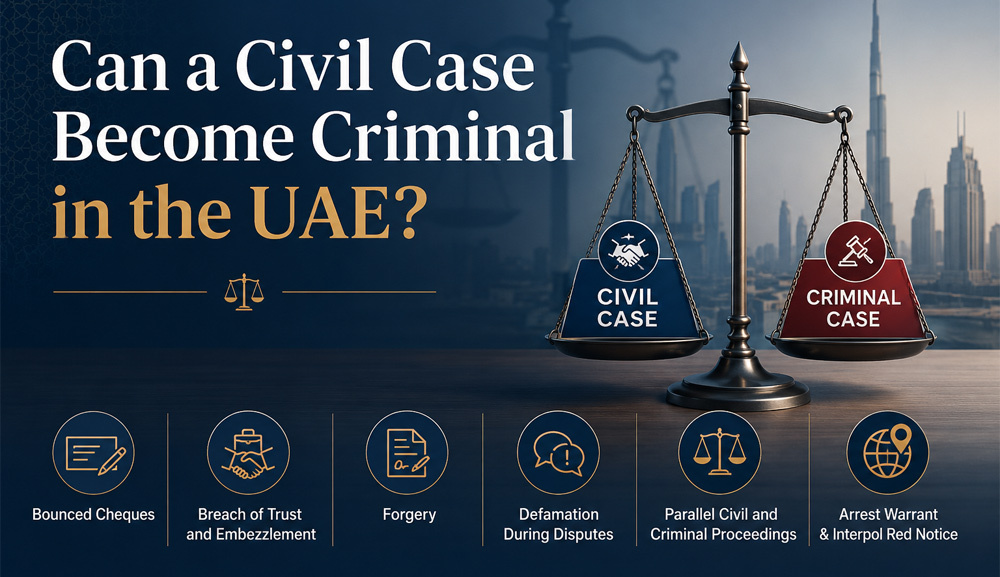
A dispute that starts as a straightforward civil matter can escalate into criminal proceedings when certain elements are present. The most common trigger is fraud. If a business dispute reveals that one party intentionally deceived the other, forged documents, or embezzled funds, those actions carry criminal liability regardless of whether a civil case is already underway.
Situations where civil disputes commonly turn criminal:
- Bounced cheques: While the UAE has partially decriminalised bounced cheques under Federal Decree-Law No. 14 of 2023, criminal liability still applies when there’s evidence of fraud or deliberate bad faith. A landlord’s rent cheque bouncing could start as a civil eviction matter and end with criminal charges.
- Breach of trust and embezzlement: Article 453 of the Penal Code criminalises situations where someone received funds or property lawfully and then misappropriated them. A partnership dispute over missing funds can quickly move from civil court to a criminal complaint.
- Forgery: If forged documents surface during a civil case, the forgery itself is a criminal offence. The court may refer the matter to the Public Prosecution.
- Defamation during disputes: If either party makes public statements or social media posts that damage the other’s reputation during a civil dispute, that’s a criminal offence under UAE law.
When a civil case turns criminal, both proceedings can run in parallel. The criminal case doesn’t replace the civil one. You might be pursuing compensation in civil court while the prosecution handles criminal charges separately. And if the accused has left the UAE, authorities can issue an arrest warrant or request an Interpol Red Notice.
Do I Need a Lawyer for Civil Disputes in Dubai?
Legally, you can represent yourself in civil cases valued below AED 500,000. Practically, doing so is risky.
UAE court proceedings are conducted in Arabic. All documents, pleadings, and submissions must be in Arabic. If you don’t speak and read Arabic fluently, you’re at a significant disadvantage from the first hearing.
Beyond language, civil procedure in the UAE has strict rules about deadlines, document formatting, evidence submission, and court etiquette. Missing a procedural deadline can get your case dismissed. Filing in the wrong court resets your timeline. Submitting improperly attested documents means they won’t be considered.
When a lawyer becomes non-negotiable:
- Claims valued above AED 500,000 (legal representation is mandatory)
- Disputes involving multiple parties or complex commercial arrangements
- Cases with potential criminal crossover (fraud, forgery, embezzlement)
- Cross-border disputes or enforcement of foreign judgments
- Cases before the DIFC or ADGM Courts (common law procedure, English language)
For criminal matters, the stakes are higher still. If you’re accused of a felony, the court is required to appoint a lawyer if you don’t have one. For misdemeanours and contraventions, representation isn’t mandatory but is strongly advisable. A criminal conviction in the UAE can mean imprisonment, a permanent record, fines, and deportation for expats.
Choosing the Right Law Firm in the UAE
Civil and criminal law require different expertise. A lawyer who excels at commercial contract disputes may not be the right person to defend you in a criminal case, and vice versa. Whether you need civil law services in Dubai or a criminal law firm in Dubai, matching the right legal advisors in Dubai, UAE to your specific situation is what determines the outcome.

For civil disputes, look for:
- Specific experience in your type of case (real estate, commercial, construction, debt recovery)
- Familiarity with the relevant court system (Dubai Courts, DIFC, federal courts, or Abu Dhabi courts)
- A track record of successful mediations and settlements, not just litigation
- Clear fee structures and realistic timelines
For criminal matters, prioritise:
- A firm with dedicated criminal defence lawyers who regularly appear in criminal courts
- Experience with the specific type of charge you’re facing
- Availability for urgent matters (bail hearings, travel ban challenges, police station representation)
- Knowledge of both the Penal Code and the Criminal Procedures Law
Many full-service law firms in the UAE handle both civil and criminal matters, which can be advantageous when a case crosses both territories. If your commercial dispute has criminal implications, having one firm that understands both sides avoids duplication and keeps your strategy coordinated. At Logicway, we help clients navigate both civil and criminal matters with legal advisors who understand the full picture.
Recent Legal Reforms: What Changed in 2025-2026
The UAE legal system has undergone significant modernisation in recent years. Several changes directly affect how civil and criminal matters are handled.
Decriminalisation of certain offences: Several petty offences, including minor traffic violations and small-scale bounced cheques, have been converted from criminal charges to administrative fines. This shift is expected to divert thousands of cases from criminal courts each year.
Stronger mediation requirements: Civil procedures now prioritise mediation and arbitration even more heavily, with reforms aimed at reducing court backlogs by an estimated 40%. If you can settle without going to trial, the system increasingly pushes you in that direction.
Enhanced cybercrime penalties: Penalties for cyberbullying leading to suicide can now reach up to seven years imprisonment. Human trafficking convictions carry life sentences with fines exceeding AED 1 million.
Electronic court procedures: Both civil and criminal courts have expanded electronic filing, virtual hearings, and digital service of process. This has significantly reduced processing times across both branches.
Connect with us today on phone or WhatsApp for quick guidance and professional legal assistance.
Frequently Asked Questions
Civil law resolves disputes between private parties through compensation and court orders. Criminal law punishes offences against society through imprisonment, fines, and deportation. The key practical difference: civil law aims to make the wronged party whole, while criminal law aims to punish the offender and deter future crimes. In the UAE, civil cases are filed by the affected party, while criminal cases are prosecuted by the Public Prosecution.
Penalties depend on the severity of the offence. Contraventions (minor offences) carry fines or short detention. Misdemeanours carry one month to three years imprisonment and/or fines. Felonies carry more than three years imprisonment, potentially life sentences, and in extreme cases, the death penalty. Corporate entities face fines up to AED 5 million. Non-UAE nationals convicted of criminal offences also face deportation after serving their sentence.
For claims below AED 500,000, legal representation is technically optional. For claims above that threshold, it’s mandatory under UAE law. Regardless of the amount, hiring a lawyer is strongly recommended because court proceedings are conducted in Arabic, procedural rules are strict, and mistakes can result in case dismissal. For criminal cases, legal representation is mandatory for felonies.
A criminal case starts with a police report, followed by investigation and referral to the Public Prosecution. The prosecution decides whether to file charges. If charges are filed, the case proceeds to the Criminal Court of First Instance, where both sides present evidence and arguments. The judge issues a verdict and, if the accused is found guilty, a sentence. The convicted person can appeal within 15 days to the Court of Appeal, and further to the Court of Cassation on points of law.
Yes. Civil disputes can escalate to criminal proceedings when fraud, forgery, embezzlement, or breach of trust is involved. Bounced cheques with criminal intent, forged documents discovered during civil litigation, and misappropriation of entrusted funds are the most common triggers. When this happens, both civil and criminal proceedings can run simultaneously. If the accused has left the country, UAE authorities can issue arrest warrants or request Interpol Red Notices.