

You’ve got a dispute. Maybe someone owes you money. Maybe a contract fell apart. Maybe a landlord is refusing to return your security deposit. And now you’re staring at the UAE legal system, wondering where to even begin.
Good news: the UAE civil court process is more structured and accessible than most people think. Bad news: one wrong step early on can cost you months of delays, or worse, get your case thrown out on a technicality.
This guide by Logicway walks you through every stage of civil case filing in UAE courts, from pre-litigation requirements all the way through to enforcement. No legal jargon without explanation. No vague “consult a lawyer” hand-waving (though yes, you’ll probably need one).
What Counts as a Civil Case in the UAE?
Before you file anything, make sure your dispute actually belongs in civil court.
Civil cases in the UAE cover disputes between individuals or entities over private rights and obligations. That includes contract disputes, property disagreements, debt recovery, insurance claims, construction conflicts, personal injury compensation, and commercial disputes between businesses.
What it doesn’t cover: criminal matters (those go through prosecution), labour disputes (handled first by the Ministry of Human Resources and Emiratisation), and family or personal status matters (separate court division with its own procedures).
The distinction matters because filing in the wrong court doesn’t just waste time. It resets your clock entirely.
Also Read Rental Dispute Resolution in UAE: Tips for Tenants and Landlords
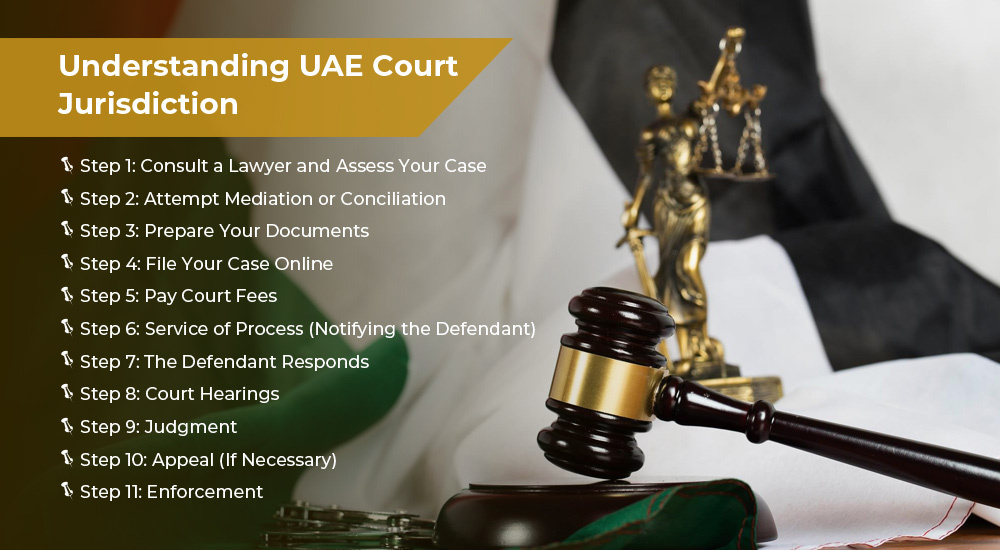
Understanding UAE Court Jurisdiction
The UAE operates a dual court system. You’ve got federal courts (covering Sharjah, Ajman, Umm Al Quwain, and Fujairah) and local courts (in Dubai, Abu Dhabi, and Ras Al Khaimah, which each maintain their own independent judiciary). Then there are free zone courts like the DIFC Courts and ADGM Courts, which follow common law principles and operate in English.
Under Federal Decree-Law No. 42 of 2022, which governs civil procedure across the UAE, jurisdiction typically falls to the court in the emirate where the defendant resides or works. For commercial cases, the plaintiff can choose between the court where the defendant is based or where the business transaction took place.
Here’s what catches people off guard: parties can also agree in advance (through a contract clause) that a specific court has jurisdiction. If your contract says “disputes shall be resolved in Dubai Courts,” that’s binding. Check your agreements before assuming where you need to file.
The court tiers work like this:
The Court of First Instance hears cases initially. Within it, the minor circuit handles claims valued at AED 100,000 or below, while the major circuit covers claims above that threshold. After a judgment, the losing party can appeal to the Court of Appeal, which reviews both facts and law. The final level is the Court of Cassation, which only reviews points of law, not facts. Cassation decisions are final and binding.
Step 1: Consult a Lawyer and Assess Your Case
This isn’t just a formality. UAE law actually requires legal representation for civil cases valued above AED 500,000, per amendments introduced to the Civil Procedures Law. Even if your claim falls below that threshold, the Arabic-language requirement for court documents makes professional help almost a necessity for non-Arabic speakers.
A good consultation accomplishes four things: it confirms whether you have a viable claim, identifies the correct court jurisdiction, maps out the evidence you’ll need, and gives you a realistic timeline and cost estimate under the UAE civil court procedure.
Don’t skip this step thinking you’ll save money. Filing errors, missed deadlines, or jurisdictional mistakes end up costing far more than an initial consultation.
Step 2: Attempt Mediation or Conciliation
Here’s something that surprises many first-time litigants: the UAE requires certain civil disputes to go through mediation or conciliation before you can file a court case.
Each emirate operates Mediation and Conciliation Centers. In Dubai, the Centre for Amicable Settlement of Disputes handles this stage. In Abu Dhabi, it’s the Reconciliation and Settlement Centre. The federal courts have their own mediation committees as well.
The process works like this. You submit your complaint to the relevant mediation centre. A mediator reviews the dispute and attempts to bring both parties to a settlement. If mediation succeeds, the agreement is enforceable like a court judgment. If it fails, the centre issues a “No Objection” letter (sometimes called a referral letter), which you’ll need before the court accepts your case filing.
The UAE also launched Wasata, an eMediation platform through the Ministry of Justice that connects disputants with registered mediators online. Sessions can be conducted in Arabic or English.
Mediation timelines vary, but most centres aim to resolve matters within two to four weeks. If the other party refuses to engage or no settlement is reached, you’ll get your referral letter and move on to formal litigation.
Step 3: Prepare Your Documents
Document preparation is where cases are won or lost before they even reach a courtroom. UAE courts are particular about what they accept and how it needs to be formatted.
Your core filing package includes:
- A statement of claim (in Arabic) that sets out the parties involved, the facts of the dispute, the legal basis for your claim, and the specific relief you’re requesting. Vague claims get rejected. Be precise about the amount you’re claiming or the action you want the court to order under the How to file a civil case in UAE process.
- Supporting evidence such as contracts, correspondence, invoices, payment records, photographs, or expert reports. Every document not originally in Arabic needs to be translated by a certified legal translator. The UAE courts won’t accept informal translations.
- Copies of identification documents, including Emirates ID, passport copies, or trade licence for companies.
- A valid Power of Attorney if you’re filing through a lawyer, which needs to be notarised and attested.
- The “No Objection” or referral letter from the relevant mediation centre (as discussed in Step 2).
A practical tip: organise your evidence chronologically and create an index. Judges handle hundreds of cases. Making yours easy to follow isn’t just courtesy; it’s strategy.
Step 4: File Your Case Online
The days of standing in queue at a court building are mostly behind us. The UAE has moved heavily toward digital filing, and understanding the online platforms saves considerable time.
For federal courts (Sharjah, Ajman, Umm Al Quwain, Fujairah), use the Ministry of Justice eFiling portal at moj.gov.ae. The system allows you to file cases, upload documents, pay fees, and track case progress, all electronically.
For Dubai Courts, the Smart Services portal handles everything from case registration to hearing notifications. You can access it through the Dubai Courts website or their mobile app
making the Dubai civil court process more efficient
For Abu Dhabi, the Abu Dhabi Judicial Department (ADJD) has its own e-services platform for case filing and management.
The online filing process generally follows this sequence: create an account and verify your identity, select the case type (civil), enter party details for both plaintiff and defendant, upload your statement of claim and all supporting documents, pay the applicable court fees, and receive a case number and confirmation.
Once filed, the court registers your case and assigns it to a judge. The entire registration process, when done correctly, takes a matter of hours rather than days.
Step 5: Pay Court Fees
Court fees in the UAE are calculated as a percentage of the claim value, and the numbers are important to budget for upfront.
For Dubai Courts, the fee structure under Law No. 21 of 2015 (as amended) works on a tiered system. The fee is approximately 6% of the claim value for Court of First Instance cases, with minimum and maximum caps. The minimum fee is AED 500. The maximum cap varies depending on claim size: AED 20,000 for claims up to AED 500,000; AED 30,000 for claims between AED 500,001 and AED 1,000,000; and AED 40,000 for claims exceeding AED 1,000,000.
For federal courts, fees follow a similar percentage-based structure under the Federal Law Concerning Judicial Fees. The exact percentages may differ slightly from Dubai’s local fee schedule.
Fee exemptions exist for government entities, charitable endowment cases, and labour disputes filed by workers or their beneficiaries.
Keep in mind: court fees are just one part of the cost. Factor in lawyer fees, translation costs, expert witness fees (if needed), and potential appeal costs. The winning party can request the court to order the losing party to reimburse certain litigation costs, but this isn’t guaranteed and rarely covers everything.
Step 6: Service of Process (Notifying the Defendant)
After you file, the court doesn’t leave it to you to tell the other side. A court bailiff or official process server handles notification of the defendant, and this step has strict rules.
Under the Civil Procedure Code, the defendant must be served within 10 business days of the case being filed. Service can happen through personal delivery, delivery to the defendant’s place of residence or business, electronic notification (including email and SMS, as permitted under the 2022 amendments), or through publication in newspapers if the defendant cannot be located.
The 2022 reforms were a meaningful shift here. Electronic service of process is now officially recognised, which speeds up the timeline significantly compared to the old paper-based system.
If the defendant isn’t properly served, they can challenge the proceedings on that basis, potentially delaying your case by months. This is one area where the court is strict. Proper service isn’t optional; it’s foundational to a fair hearing.
Step 7: The Defendant Responds
Once served, the defendant has a set period to file their response, typically within 10 to 15 days depending on the court. The response includes their defence, any counterclaims they wish to raise, and their own supporting evidence.
If the defendant fails to respond within the deadline, the court can proceed with a default judgment in your favour. That said, default judgments are subject to appeal, so don’t assume silence means automatic victory.
Counterclaims are common. The defendant might argue that you actually owe them money, or that you breached the contract first. Be prepared for this possibility. Your lawyer should anticipate likely counterarguments during the initial case preparation.
Step 8: Court Hearings
UAE civil court hearings don’t work like the dramatic courtroom scenes you’ve seen on television. They’re procedural, relatively brief, and often spread across multiple sessions.
At the first hearing, the judge reviews the filings from both sides, asks preliminary questions, and may request additional documents or evidence. Subsequent hearings allow each party to respond to the other’s arguments and submit further evidence.
Hearings are conducted in Arabic. If you don’t speak Arabic, you’ll need a court-approved translator present during your hearings.
The judge may also appoint an expert witness to evaluate technical aspects of the dispute, particularly common in construction cases, financial disputes, or property valuation matters. Expert reports carry significant weight in UAE courts, so take this stage seriously.
The overall timeline varies. Straightforward cases with clear documentation can reach judgment in 90 to 120 days from filing. Complex commercial disputes might take six months to over a year at the Court of First Instance level alone.
Step 9: Judgment
After reviewing all evidence, hearing both parties, and considering any expert reports, the judge issues a written judgment. The judgment specifies whether the claim succeeds (fully or partially), the amount of compensation or specific performance ordered, how court costs and fees are allocated, and the deadline for compliance.
Judgments from the Court of First Instance are typically issued within a few weeks of the final hearing session.
Step 10: Appeal (If Necessary)
Not satisfied with the outcome? The losing party has 30 days from the date of judgment to file an appeal.
The Court of Appeal conducts a full review of both the facts and the law. It can uphold the original decision, modify it, or overturn it entirely. New evidence can sometimes be introduced at this stage, though the circumstances for doing so are limited.
If the appeal decision still doesn’t resolve matters, a further appeal to the Court of Cassation is possible, but only on points of law. The Cassation court won’t re-examine facts. It looks at whether the law was correctly interpreted and applied. Cassation decisions are final.
An important consideration: filing an appeal doesn’t automatically suspend enforcement of the original judgment. If you need enforcement paused while you appeal, you must request a separate stay of execution from the court.
Step 11: Enforcement
A judgment is only as good as its enforcement. If the losing party doesn’t comply voluntarily, the winning party files an enforcement application with the Execution Court.
The Execution Court has broad powers: seizing bank accounts, freezing assets, imposing travel bans, and even ordering imprisonment for non-compliance with financial judgments (though this is a last resort). The enforcement process has its own fees and timelines, but it gives real teeth to court judgments in the UAE.
For cross-border enforcement, the UAE is party to several bilateral and multilateral agreements that allow UAE court judgments to be recognised and enforced in other countries, and vice versa.
Key Timelines at a Glance
| Stage | Typical Duration |
| Mediation | 2–4 weeks |
| Case filing and registration | 1–2 days (e-filing) |
| Service of process | Up to 10 business days |
| Defendant’s response window | 10–15 days |
| Court of First Instance proceedings | 3–12 months |
| Appeal | 2–6 months (additional) |
| Cassation review | 2–4 months (if applicable) |
A straightforward civil claim with no appeals can be resolved in four to six months total. A contested case that goes through all three court levels could take 18 months or longer under the Civil claim process Dubai.
Practical Tips for a Stronger Case
Document everything from day one. The moment a dispute looks possible, start preserving evidence. Save emails, text messages, contracts, receipts, and photos. UAE courts weigh documentary evidence heavily.
Don’t ignore settlement offers. The court looks favourably on parties who demonstrate willingness to settle. Unreasonable refusal to negotiate can influence cost allocations.
Meet every deadline. UAE courts enforce procedural timelines strictly. Missing a filing deadline can result in your case being dismissed or your defence being struck.
Get documents translated early. Certified Arabic translations take time. Don’t wait until the week before filing to start this process.
Choose your lawyer carefully. Look for someone with specific experience in your type of dispute and the relevant court system. A real estate lawyer isn’t automatically the right choice for a commercial debt case.
Contact Logic Way today to get expert guidance and support for resolving your tenancy disputes with confidence.
Frequently Asked Questions
Court fees are typically 6% of the claim value, with a minimum of AED 500 and a maximum cap of AED 40,000 for high-value claims. Total litigation costs including lawyer fees, translation, and expert witnesses vary widely but typically range from AED 15,000 to AED 100,000 or more depending on the claim’s complexity and value.
Technically yes, for claims valued below AED 500,000. But court proceedings are conducted in Arabic, and procedural requirements are strict. Self-representation is possible but risky for anyone unfamiliar with UAE legal procedures. For claims above AED 500,000, legal representation is mandatory.
Simple cases can be resolved in three to six months. Contested cases with appeals may take 12 to 18 months. The 2022 reforms introduced measures to speed up proceedings, and courts now aim to resolve straightforward matters within 90 to 120 days from filing.
Yes. The Ministry of Justice eFiling portal handles federal court filings, Dubai Courts Smart Services portal handles Dubai filings, and the Abu Dhabi Judicial Department has its own e-services platform. Online filing is now the standard method across most UAE courts.
You’ll need a statement of claim (in Arabic), supporting evidence, identification documents (Emirates ID or passport), a Power of Attorney if using a lawyer, and a “No Objection” letter from the relevant mediation centre. All non-Arabic documents must be certified translated.
For most civil disputes, yes. Parties are required to attempt mediation or conciliation through the relevant centre before proceeding to court. If mediation fails, the centre issues a referral letter that you need to file your court case.
The DIFC Courts are a separate common-law jurisdiction within Dubai that handles civil and commercial disputes connected to the Dubai International Financial Centre. They operate in English and follow common-law procedures, making them distinct from the mainland UAE courts that follow civil law traditions.
Yes. Appeals must be filed within 30 days of the judgment. The Court of Appeal reviews both facts and law. A further appeal to the Court of Cassation is possible but limited to questions of law only. Cassation decisions are final.